
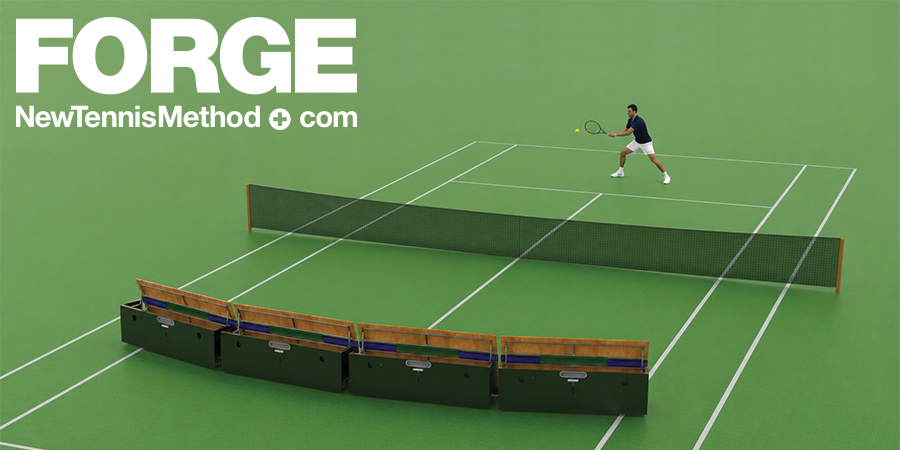
Forge introduces a different idea: change the environment itself.
Developed as part of New Tennis Method, Forge is a highly stable, mobile barrier designed for tennis training at different levels. Instead of simply telling a player where to move, where to hit, or which space to cover, Forge can physically redefine the court and create new situations for players to solve.
That makes it more than another training accessory. It becomes a tool for designing new tennis exercises.
A Physical Constraint Changes the Exercise
One of the challenges in tennis coaching is translating an instruction into something a player instinctively understands.
A coach can tell a player to:
- Recover differently
- Avoid a particular area
- Change the direction of the ball
- Attack a specific space
- Modify their positioning
But verbal instructions still leave the player responsible for imagining the boundary.
Forge makes that boundary physical.
By positioning a barrier on the court, a coach can alter the available space and force the player to adapt. Movement, positioning, decision-making, and shot selection can all become part of the exercise without relying solely on verbal instructions.
The result is training built around constraints and situations rather than repetition alone.
One Product, Many Training Possibilities
There is deliberately no single prescribed way to use Forge.
New Tennis Method is exploring how Forge can be incorporated into different areas of the game, including:
- Recreational tennis
- Doubles training
- Junior development
The platform actively asks players and coaches to contribute their own ideas for these categories through its community suggestions.
That opens up a wide range of possibilities.
In recreational training, Forge can help turn an abstract coaching instruction into an easy-to-understand spatial challenge.
For juniors, physical boundaries can help create exercises that are visual, immediate, and engaging rather than overly dependent on technical explanations.
In doubles, where court positioning and the relationship between partners are fundamental, changing the usable space creates opportunities to experiment with movement, coverage, and tactical decisions.
Even small changes in the location and angle of the barrier can create a different problem for the player to solve.
And that is exactly what New Tennis Method is exploring: not simply another way to repeat tennis drills, but new ways to train the game itself.
| next |